
Ministry of Transport · ISTRC 2026
Traffic Count Sampling Design
Where should a metropolitan traffic survey count when it cannot count every road? I led the development of a centrality-based method that prioritizes eligible locations within traffic zones, supporting practical surveys for strategic transport-model validation.
Follow the story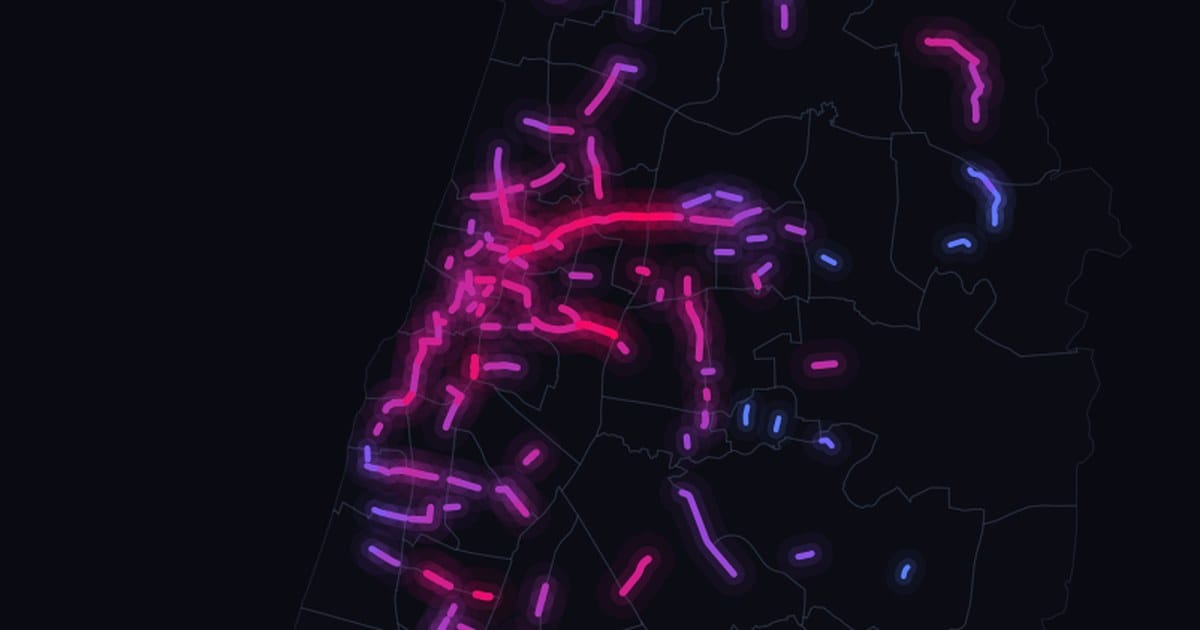 CASE STUDY / 02
The question
From Vague Guidelines to a Transparent Algorithm
Survey budgets, equipment and field conditions limit how many roads can be measured. The task is to choose useful locations across a metropolitan network. Our workflow combines network centrality, eligibility rules and selection within traffic zones to make that choice transparent and repeatable.
- My contribution
- Developing a centrality-based method for selecting metropolitan traffic-count locations.
- The deliverable
- A ranked, zone-based sample of eligible road segments across four metropolitan models.
- What it enables
- Planning a practical survey when budget and field conditions make counting every road impossible.
The approach / 01
Define suitable count locations: road class, access and minimum segment length restrict which links can be selected. The network used for path calculations and the eligible survey locations serve different purposes.
The approach / 02
Compute betweenness centrality: calculate shortest paths using travel-time weights and accumulate how often they pass through each link. This describes the structure of the network, not observed traffic volume.
The approach / 03
Apply trip-distance constraints by road class. These determine which journeys contribute to a link’s centrality, helping the measure reflect metropolitan connections. This is different from weighting routes by distance.
The approach / 04
Select within traffic zones: rank eligible links by centrality and apply the configured sampling target. The current export uses 20% per zone, with rounding and minimum-selection rules; the total can therefore exceed 20%.
The approach / 05
Review the proposed sample in its geographic and operational context. Zones without eligible links and selected links outside zone boundaries remain explicit, rather than being hidden by a claim of complete coverage.
The evidence
Four Metropolitan Areas, One Algorithm
The methodology was applied to Israel's four metropolitan strategic models. Across the four, 774 count locations were selected out of 3,551 eligible metropolitan links — about 22%, using a 20% per-zone target with rounding and minimum-selection rules. Each map shows the selected links glowing over the model's traffic analysis zones, colored by betweenness centrality score.
Loading the interactive visualization…
What you are seeingSelected road segments and traffic zones. Centrality describes network structure; it is not a measurement of traffic volume.
The Science, Simply
The Science, Simply
Betweenness centrality asks how often a road link lies on shortest paths through the network. Here, shortest means lowest modeled travel time. The distance-constrained calculation credits paths according to their trip distance and the link’s road class. The map’s color scale is a display choice; it does not change the underlying selection.
Within each traffic zone, eligible links are ranked by centrality. A configurable target determines how many are selected. This balances network importance with geographic distribution, while leaving field feasibility and available survey resources part of the planning process.
Loading the interactive visualization…
Illustrative network demonstration — not observed traffic data.for each zone: select top 20% of class 4–5 links, ranked by Cᵦ(e)Cᵦ(e) is the link’s centrality from travel-time-weighted paths with road-class trip-distance constraints. Selection uses eligible links within each zone, with rounding and minimum-selection rules. Centrality is not a forecast of traffic volume.
ISTRC / 2026
Presented at ISTRC 2026
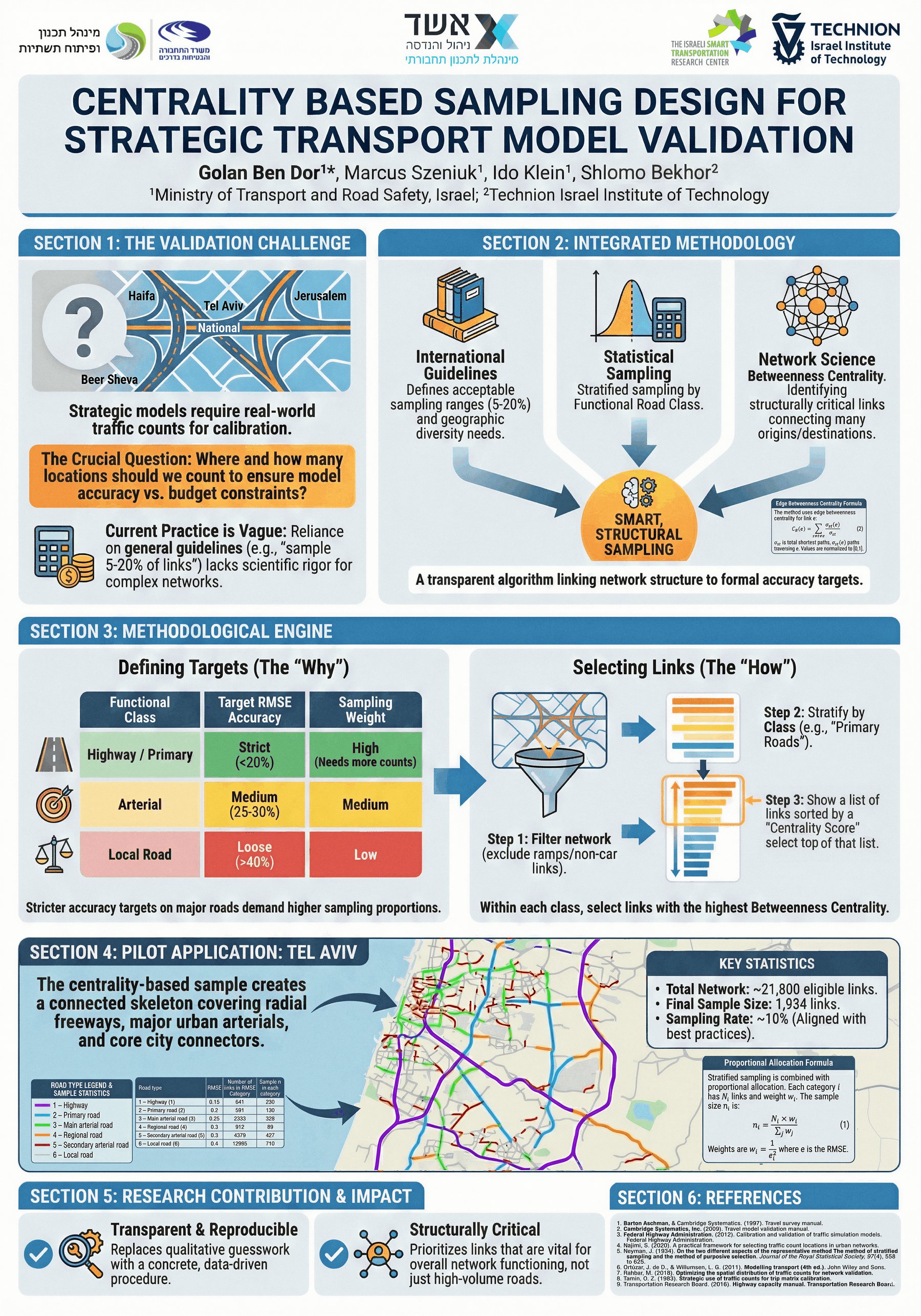
The methodology was presented as a poster paper at the Israel Section of Transportation Research Conference 2026. The poster describes the general sampling framework; the version deployed for the four metropolitan areas extends it with distance-based centrality and per-zone selection, tuned for metropolitan roads.
View Full-Size PosterWhy It Matters
From evidence to a decision.
The deliverable is a traceable survey proposal: why locations were selected, how the sample is distributed and which constraints were applied. Agencies can review it against field conditions and available resources before collecting counts for model validation.
When we cannot measure every road, the choice of where to count should be explicit, explainable and repeatable.Get in Touch
The next perspective
Jerusalem Congestion Pricing Study
Simulation-based policy evaluation using MATSim.
Explore case studyAll projects